12 November 2024 · 4 min read
How should saffron be grown?
Saffron is a rare and valuable plant.
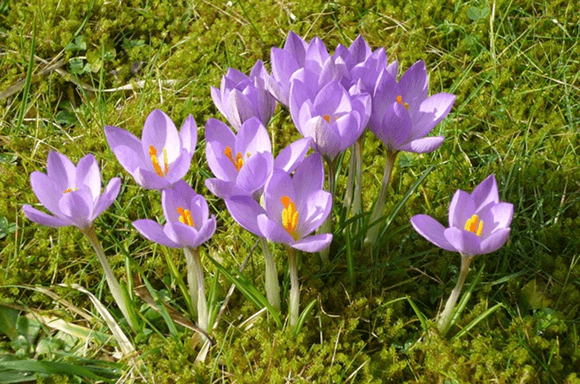
In our country this valuable plant can be harvested only on the Absheron peninsula. Many species of saffron are found around the world. Only one of them is grown as a crop. The underground part of that species consists of round corms. Saffron is propagated by these corms. The leaves are narrow, elongated and dark green. They reach 44-50 cm in length. Each flower has six petals. How well a corm flowers depends on its size. Very few corms 1-2 cm across flower at all. Corms 2-3 cm across give one flower each on average. Corms 3-4 cm across give 4-5 flowers each, and those over 4 cm give 8-9 flowers each.
On Absheron, saffron is planted in July and August. The spacing between rows should be 50 cm and between corms in a row 8 cm. Planted closer than that, the crop loses quality. The corms go in at a depth of 15-20 cm. Cultivation should begin once the flower picking is over. At that point the ground between the rows needs to be worked. The tines of the cultivator nearest the row should go 8-10 cm deep and the middle tines 16 cm. The outer tines of the cultivator should pass 10 cm clear of the row. Working the ground between the rows loosens soil trodden hard during picking and lets air in more easily. The protective strip left at the sides of the rows is loosened with a mattock and the row itself with an iron rake, and the weeds are cleared. The gaps between the rake teeth must be such that, in use, the rake does not catch the shoots and break them. Later, when weeds appear between the rows or a crust forms after watering, the soil is loosened again with the cultivator.
The light grey soils of Absheron are low in nutrients. When the ground is prepared for planting, therefore, extra fertiliser has to be applied to the field. Once the flowers have been picked, the plant starts to grow fast. (Late November or early December). The first application can therefore be spread in early December. Since enough superphosphate and potassium salt goes into the soil at planting, only ammonium nitrate is used as a top dressing. In December and February 150 kg of ammonium nitrate per hectare is applied, and from the second year a further 200 kg of superphosphate and 100 kg of potassium salt per hectare. Spreading the same amount of fertiliser over the whole field is not right, because the roots of saffron run straight down without branching. Fertiliser placed to the side is of no use to the plant. Watering raises the yield of saffron and the output of corms. When watering, however, the biology of the plant has to be taken into account. Above all, remember that when it rains in early autumn the vegetative parts of saffron develop quickly. Water should then be given sparingly. If the autumn is dry, the plants are watered only in October.
The main pests of saffron are hares and mice. Hares eat saffron leaves with great appetite. Mice make nests underground and damage the corms, or eat them whole. On damaged corms the parts above ground and the leaves turn yellow and dry out. Jerboas and mice can be destroyed by placing wheat grain mixed with zinc phosphide in the burrow. The fungal diseases rhizoctonia and sclerotinia are enemies of saffron too. On a plantation struck by rhizoctonia the leaves turn yellow. The mycelium of the fungus covers the surface of the corms and gradually works its way inside.
Hollows filled with a soot-like mass form on the diseased corms. Corms infected with sclerotinia begin to sprout. Corms struck by either disease should be picked out at once and treated with formalin before planting. The plant was brought to Absheron from Asia Minor in the eighth to ninth centuries. Until 1941, up to 600 kg of dry saffron was prepared on the peninsula each year.
MORE